
When I think about Hawaii, I picture beautiful beaches, lush forests, and powerful volcanoes. Eruptions have shaped the Hawaiian Islands for millions of years.

Dramatic volcanic events built the land and changed people’s lives throughout Hawaii’s history.
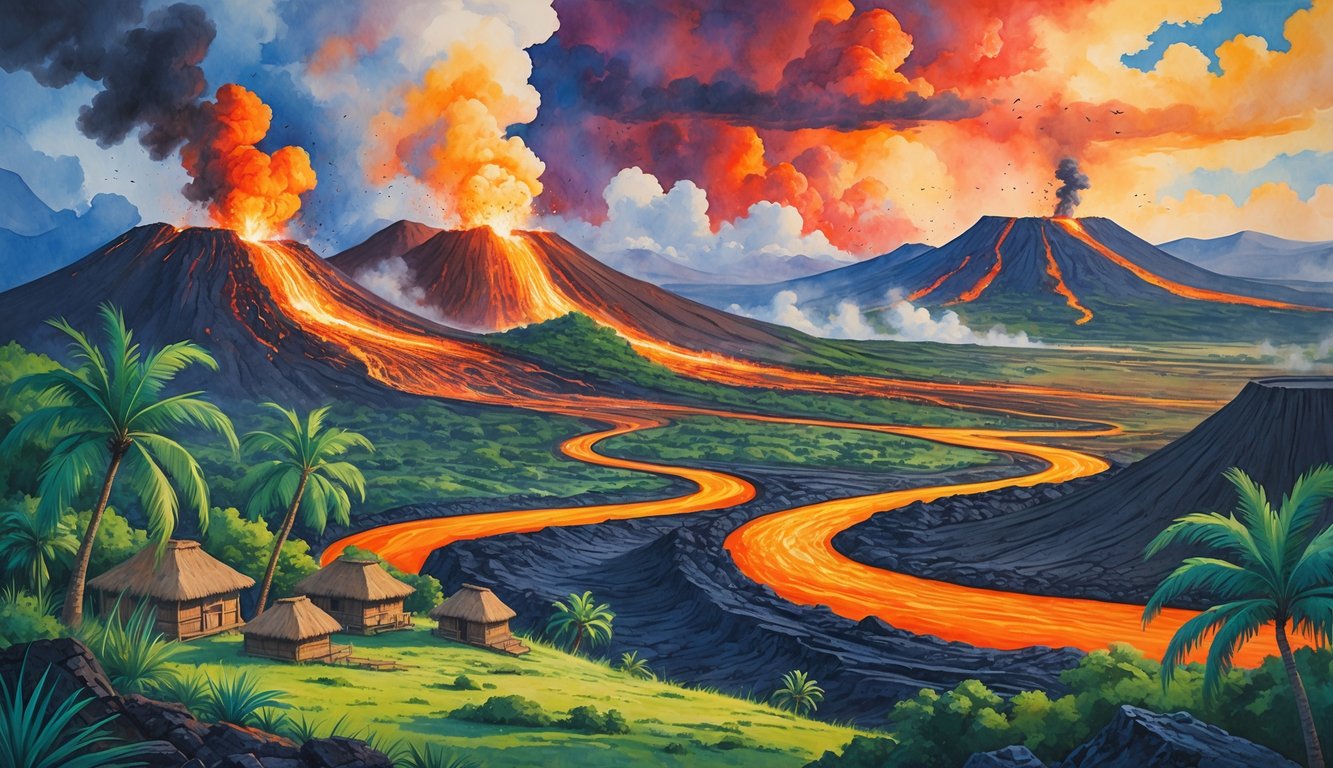
Some volcanoes on the Big Island, like Kīlauea and Mauna Loa, are among the most active in the world. They still erupt often, creating new land and fresh stories.
Eruptions also take place underwater, like those from Kama’ehuakanaloa just off the coast. These eruptions show that Hawaii keeps growing and changing every day.
Learning about Hawaiian eruptions goes beyond lava and explosions. It helps us understand how the islands formed and how volcanoes continue to shape them.
If you’re curious about what makes Hawaii unique, start with the story of its volcanoes.
Origins of Volcanism in Hawaii
The Hawaiian Islands formed as the Earth’s crust moved over a stationary heat source deep below the ocean. Each island shows signs of unique volcanic growth stages and shifting tectonic plates.
Hawaiian Hotspot Theory
The main reason for Hawaii‘s volcanoes is a fixed heat source called the *Hawaiian
Historical Eruptions and Records
I begin my look at volcanic activity in Hawaii long before written accounts. Some eruptions shaped the islands and changed how people lived.
Eruption records give insights into eruption rates, major events, and cultural meaning.
Prehistoric and Ancient Eruptions
Before humans arrived, volcanic eruptions built the foundation of Hawaii. The islands grew along the Hawaiian Ridge as underwater eruptions formed the Emperor Seamount Chain.
Old lava layers still cover much of the land. When Polynesians first reached Hawaii, the volcanoes were active and unpredictable.
Ancient stories describe Pele, the Hawaiian goddess of volcanoes, who symbolized both destruction and creation. These stories help me understand how early Hawaiians respected and feared the volcanoes.
Archaeological studies reveal that lava flows sometimes forced entire villages to move. Evidence of old eruptions includes buried forests and ancient footprints set in hardened ash.
Even without written records from this time, the landscape itself holds clues about eruption history.
Recorded History of Volcanic Eruptions
Written records of volcanic eruptions in Hawaii began in the late 1700s. The first major event documented was an explosive eruption at Kilauea in 1790, which caused many deaths.
Since then, Mauna Loa and Kilauea have erupted often, along with smaller events at Hualālai and other volcanoes. Eruption records show that Hawaiian volcanic activity happens frequently.
Some eruptions lasted only hours, while others, like Kilauea’s eruptions in the 20th and 21st centuries, lasted for years. The United States Geological Survey tracks eruptions, impacts, and changes over time (recent volcanic activity on the Island of Hawai’i).
Scientists use this data to estimate eruption rates for each volcano. These patterns help predict future activity and keep people safe.
Notable Hawaiian Eruptions
Some eruptions have changed life on the islands. The 1790 Kilauea eruption killed many people as ash and gas covered trails.
The Mauna Loa eruptions in 1880-1881 sent lava close to Hilo, but the town escaped destruction. Kilauea’s eruptions from 1983 to 2018 created new land and destroyed homes.
Scientists observed active lava flows during these years. Mauna Loa’s 2022 eruption lasted only a few weeks and showed how quickly things can change (Mauna Loa eruption history).
Below is a short table showing notable events:
| Volcano | Year(s) | Event |
|---|---|---|
| Kilauea | 1790 | Deadly explosive |
| Mauna Loa | 1880-1881 | Lava threatened Hilo |
| Kilauea | 1983-2018 | Long eruption |
| Mauna Loa | 2022 | Brief reactivation |
Recent and Significant Eruptions
Hawaii has experienced several major volcanic eruptions in the last two decades. Each event brought unique changes to the island’s landscape and affected local communities.
2008–2018 Summit Eruption
The 2008–2018 summit eruption of Kīlauea lasted for ten years. A new vent opened at Halemaʻumaʻu crater, sending out a steady plume of ash and gas.
This created a lava lake that remained active for a decade. Vog (volcanic smog) from the eruption often reached Hilo and other areas, making the air hazy.
Park officials closed parks often for safety reasons. The eruption caused ground shaking and small explosions at the summit.
In 2018, the lava lake and surrounding area dropped suddenly, causing dramatic summit collapses. These collapses left deep craters and cracks across the landscape.
You can read a detailed timeline at the U.S. Geological Survey’s chronology of volcanic activity.
2018 Kīlauea Eruption
In May 2018, Kīlauea erupted in one of its most destructive events. Fissures opened in the lower East Rift Zone and sent lava through neighborhoods.
Entire communities, including Leilani Estates, faced danger. Families lost homes, and roads vanished under fast-moving lava.
Lava flows reached the ocean, creating new land along the coast and sending clouds of steam and glass particles into the air. The eruption forced thousands to evacuate, and hundreds of homes were lost.
During this time, the summit area called Kaluapele changed dramatically, with more collapses and large ash explosions. These changes reshaped the volcano’s top.
You can learn more at Hawaii Guide’s eruption history page.
2022 Mauna Loa Eruption
Mauna Loa, the world’s largest active volcano, erupted in 2022 for the first time in nearly 40 years. The eruption began at the summit and moved down the northeast rift zone.
Bright fountains of lava lit up the night sky. The lava flows threatened a key highway that connects the eastern and western parts of the island but stopped just short of reaching it.
Many people watched closely as emergency crews stayed alert. Although the eruption did not destroy any homes, it showed how quickly life can change when a volcano awakens.
Mauna Loa’s eruption was closely monitored, and groups like the National Park Service provided updates to keep everyone informed and safe.
Volcanic Activity Monitoring and Research
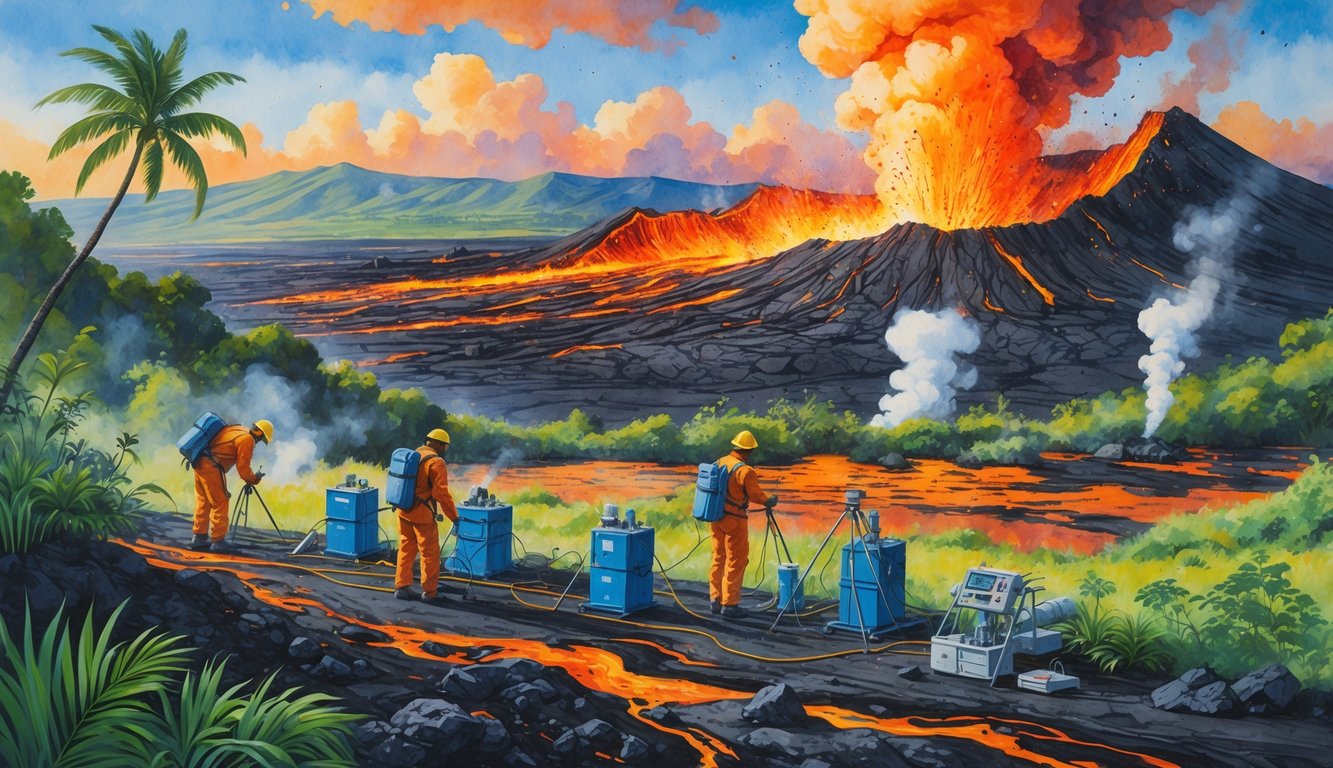
I pay close attention to the technology and science behind volcano research. Studying eruptions in Hawaii requires constant monitoring, special equipment, and a team of dedicated scientists.
Hawaiian Volcano Observatory
The Hawaiian Volcano Observatory (HVO) is my main source for volcano updates. Founded in 1912, HVO sits on the rim of Kīlauea’s caldera and tracks eruptions and earthquakes with a network of monitoring tools.
These tools include seismometers, tiltmeters, and gas sensors. HVO’s staff work around the clock, checking seismic stations and webcams, and analyzing satellite data.
They gather real-time information and make quick decisions about public safety. HVO can respond quickly to sudden changes.
With both on-site and remote monitoring, HVO helps reduce risks for people living near or visiting Hawaii’s active volcanoes. Learn more from the Hawaiian Volcano Observatory.
USGS Involvement
The United States Geological Survey (USGS) plays a big role in Hawaii’s volcano research. USGS experts run HVO and provide technical support, funding, and updated equipment.
Through USGS programs, I can access current eruption updates, hazard maps, and official warnings. The USGS monitors Kīlauea, Mauna Loa, and other Hawaiian volcanoes that may pose a threat in the future.
USGS scientists share findings with local governments and the public. Their work helps schools, businesses, and families prepare for emergencies.
They also create interactive tools for people to track volcanic activity online. You can stay updated on Kīlauea’s status and find detailed reports on the USGS website.
Geophysical Studies and Seismic Activity
To understand volcanoes, I look at geophysical studies. Researchers use tools like GPS stations, geophones, and infrasound arrays to measure ground movement, heat flow, and sound waves.
Seismic activity is a key sign that a volcano might erupt. By recording hundreds of small earthquakes each week, scientists spot changes in magma movement deep underground.
This helps them predict when an eruption is more likely.
Main geophysical methods:
- Seismology: Monitoring earthquakes with seismometers
- Ground deformation: Checking for uplift or sinking using GPS and tiltmeters
- Gas emission analysis: Measuring volcanic gases like sulfur dioxide
These research methods give a detailed view of what’s happening below the surface.
Petrology and Geochemistry
Petrology and geochemistry help me learn about the makeup of Hawaiian lava. Petrologists collect fresh lava rock samples during and after eruptions.
They study mineral content and texture. Geochemists analyze the lava’s chemical composition, looking at elements such as silicon, magnesium, and iron.
This lets them trace the sources and movements of magma deep inside Earth. The results show if magma is new or recycled from earlier eruptions.
They also reveal how fast gases escape, which affects eruption style. By understanding these details, I see how each eruption is different and how Hawaii’s volcanoes keep changing.
Long-Term Effects of Volcanic Eruptions
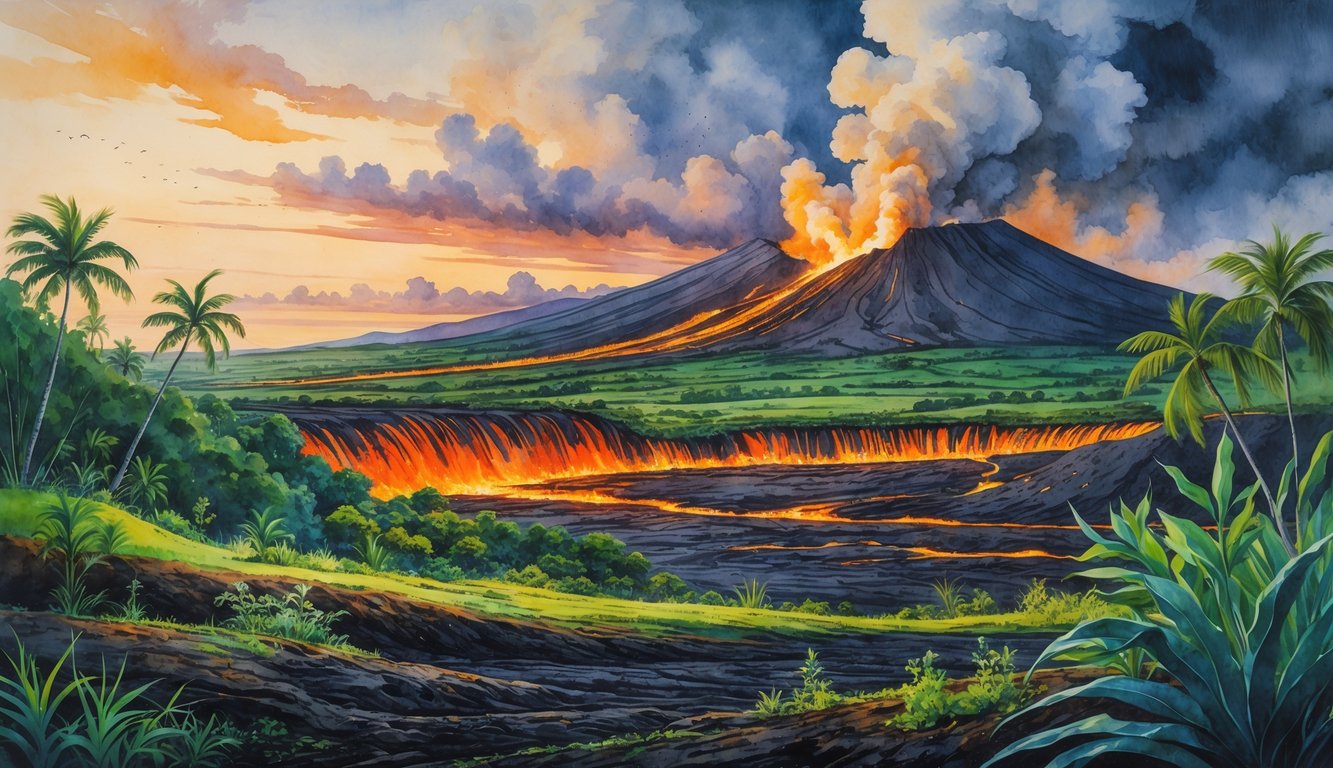
Volcanic eruptions in Hawaii shape the land and ocean life for many years after the eruption ends. They change the coastlines, impact underwater habitats, and affect how safe the land is for people.
Erosion and Subsidence
After lava cools and hardens into new land, Hawaii’s rough climate—wind, rain, and waves—starts to wear it down. This slow process, called erosion, can reshape the coastline for centuries.
Sometimes, large pieces of rock erode and fall into the sea. Another concern is subsidence.
When new lava and ash add weight, the land can sink. This makes some low-lying areas more likely to flood during storms or high tides.
Even years after an eruption, changes in ground level continue and quietly reshape the landscape.
Landslides and Island Formation
Large eruptions leave behind steep, unstable slopes. Over time, parts of these slopes can break off and slide down, causing landslides.
In Hawaii, these landslides sometimes move huge amounts of earth into the ocean and change the coastline instantly. Some landslides happen underwater, which can cause tsunamis or shift where coral reefs grow.
Repeated lava flows slowly build up new land, making the islands grow outward. New land provides habitat for plants and animals, but it can take years before life fully returns.
Impact on Coral Reefs and Ecosystems
When an eruption sends ash and lava into the ocean, it can damage coral reefs close to shore. The heat and chemicals from lava kill corals, while ash and sediment block sunlight and make it hard for new corals to grow.
As new land cools and breaks apart, it creates new surfaces for corals and other sea creatures to settle on. Large eruptions can disrupt local fisheries and change the mix of species underwater for years, as detailed in studies reviewed by the USGS.
Sometimes unique plant and animal communities develop on new land and reefs, giving Hawaii its famous biodiversity.
Cultural and Societal Impacts of Hawaii’s Volcanoes
Volcanoes shape my daily life, spiritual beliefs, and even the layout of my towns and fields.
Their eruptions bring new land and challenges, but they also connect people, nature, and tradition in Hawaii.
Volcanoes in Hawaiian Mythology
When I think about Hawaii’s volcanoes, I remember Pele, the volcano goddess.
Pele lives in the Halemaʻumaʻu crater at Kīlauea and is an important figure in many stories and legends.
Families often make offerings to Pele, such as flowers or food, to ask for safety or good luck.
Myths about her explain new lava flows or the creation of land.
These stories make volcanoes feel alive and connected to my family’s history.
Oahu, another island in Hawaii, does not have active volcanoes today, but it still has old craters from long ago.
Legends about volcanoes reach all the islands, tying together different Hawaiian communities through shared stories and respect for Pele.
Below is a list of traditional ways people honor Pele:
- Hula dances that tell Pele’s story
- Leis or food offerings left at craters
- Chants and prayers passed down for generations
Influence on Local Communities
Living near volcanoes affects many parts of my life.
Volcanic eruptions destroy homes, cover roads, and make farmland unusable.
Some families move after an eruption.
But eruptions also create new land with rich, dark soil, which helps farming.
New plants often grow soon after lava cools.
Even animals find ways to adapt or thrive in these new habitats.
Local people build towns and farms in areas that can be risky.
Traditions and culture keep my ties to these places strong.
We help each other after disasters with supplies, shelter, or by rebuilding homes together.
These group efforts become a part of my community’s identity.
I often picture families working together, cleaning up ash, planting kalo (taro), or sharing stories about past eruptions.
Tourism and Education
Hawaii’s volcanoes draw visitors from around the world. People come to hike on lava trails, watch eruptions safely from a distance, or visit museums and cultural sites at places such as Hawai‘i Volcanoes National Park.
Many visitors learn about volcano science and Hawaiian culture at these sites. Tour guides share legends about Pele and explain how eruptions shape the land.
Schools in Hawaii bring students on field trips to learn about geology and history firsthand. These activities teach everyone about the challenges and beauty of living near volcanoes.
Fun fact: The parks and sites use signs and guides in both English and Hawaiian to share information about native plants, animals, and traditions. This helps connect visitors and locals to the story of volcanoes in Hawaii.
For more details about Hawaii’s volcanoes and their cultural connections, check out this guide to Hawaii’s volcanic legacy or learn what’s happening in Hawaiʻi Volcanoes National Park.


