
In the heart of Honolulu on the island of Oʻahu stands a landmark unlike any other in the United States.

ʻIolani Palace served as the official royal residence for the last monarchs of the Hawaiian Kingdom, including King Kalākaua and Queen Liliʻuokalani.
King Kalākaua and Queen Liliʻuokalani lived and ruled here.
The palace, built in 1882, became both a political center and a symbol of Hawaiian sovereignty until the monarchy’s overthrow in 1893.
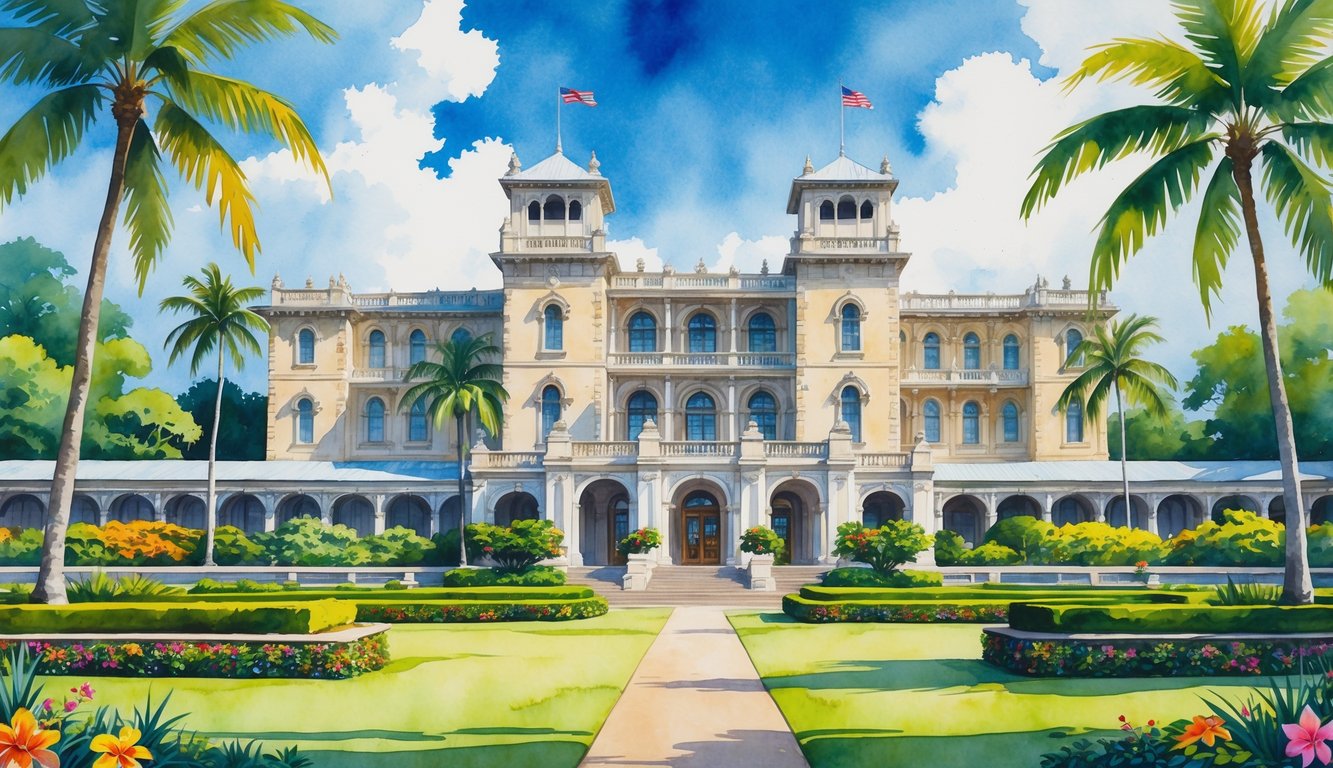
Architects designed the palace by blending Western styles with Hawaiian cultural details.
The palace hosted state functions, welcomed foreign dignitaries, and played a central role in Hawaiian history.
After the monarchy fell, government officials used the building as the capitol for decades.
Today, ʻIolani Palace stands restored and offers a window into the political and cultural life of 19th-century Hawaiʻi.
Its rooms and artifacts connect the past to the present, making it one of Honolulu’s most important historic sites.
Origins and Construction of ʻIolani Palace
Builders constructed ʻIolani Palace in downtown Honolulu during a time of political change and cultural pride in the Hawaiian Kingdom.
Hawaiian rulers wanted to modernize and showcase the islands’ status to the world.
Establishment of the Hawaiian Monarchy
The Hawaiian monarchy began formal governance in 1845 when King Kamehameha III moved the capital to Honolulu on Oʻahu.
This move centralized political power and led to the creation of important state structures.
Earlier royal residences, including a simple wooden building, stood on the palace grounds before the current palace.
King Kamehameha V renamed the site “ʻIolani Palace” in 1877 to honor his brother, Alexander Liholiho ʻIolani, also known as Kamehameha IV.
The name “ʻIolani” means “royal hawk” in Hawaiian.
By the late 19th century, the Hawaiian Kingdom wanted a residence that could host foreign dignitaries and reflect its independence.
This vision led to the construction of a new, grand palace.
Architectural Design and Innovations
Workers began construction after laying the cornerstone on December 31, 1879, with full Masonic rites.
They completed the palace in 1882, creating the only royal palace in the United States.
The building’s style is called American Florentine, which blends Italian Renaissance features with local adaptations.
Builders used plastered brick, concrete, and iron detailing for durability.
Key features included:
- Two-story façade measuring about 140 feet long and 54 feet high
- Central tower and two end towers topped with square campaniles
- Large reception halls for state events
The palace had electric lighting and indoor plumbing, which were modern amenities at the time.
These features made it a symbol of progress in Honolulu.
Role of King Kalākaua
King Kalākaua, who reigned from 1874 to 1891, commissioned the palace as part of his efforts to strengthen the Hawaiian monarchy.
He wanted a residence that would rival royal buildings abroad and show the nation’s sovereignty.
Kalākaua oversaw the design and included both European influences and Hawaiian cultural elements.
He believed architecture could communicate political strength.
The palace became a center for official functions where Kalākaua welcomed leaders from around the world.
It also served as a venue for cultural celebrations, reinforcing the identity of the Hawaiian Kingdom.
You can learn more about the history of ʻIolani Palace and its place in Hawaii’s past.
ʻIolani Palace During the Hawaiian Kingdom Era
ʻIolani Palace served as the official seat of the Hawaiian monarchy and the home of its last two rulers.
Political decisions shaped the Hawaiian Islands here, and cultural traditions were celebrated in both private and public life.
Political and Cultural Center
When King Kalākaua completed ʻIolani Palace in 1882, it became the center of government for the Hawaiian Kingdom.
Leaders met in the throne room, legislative chambers, and offices to discuss laws and policies.
The Palace also served as a stage for cultural pride.
Kalākaua promoted Hawaiian traditions alongside modern advancements and hosted events that blended Western customs with native practices.
The Royal Hawaiian Band, established by the king, performed regularly on the palace grounds.
Music, hula, and speeches often marked important gatherings.
These events reinforced Hawaiian identity during a time of growing foreign influence.
Public celebrations and diplomatic receptions welcomed visitors from across the Pacific and beyond.
This made the Palace a symbol of sovereignty for the Hawaiian people.
Royal Family Life and Traditions
King Kalākaua and his sister, Queen Liliʻuokalani, lived at the Palace with close family members and attendants.
Daily life included both formal duties and personal moments in the private suites.
The royal family valued Hawaiian customs.
Kalākaua revived the public performance of hula, which earlier missionaries had discouraged.
He also encouraged the use of the Hawaiian language in court life.
Meals often featured local foods and imported dishes.
The Palace’s design reflected a mix of Hawaiian craftsmanship and Western architecture.
Family gatherings, music sessions, and storytelling kept cultural practices alive within the royal household.
These traditions helped maintain a strong connection to the islands’ heritage.
Historic Events and Ceremonies
ʻIolani Palace hosted state occasions, such as the king’s birthday celebrations, coronations, and receptions for foreign dignitaries.
One of the most notable events was Kalākaua’s coronation in 1883, which included a grand procession through Honolulu.
Diplomatic ceremonies strengthened ties with other nations.
Leaders from the Pacific and beyond attended banquets and formal audiences in the Palace’s grand halls.
The Palace grounds also welcomed community events.
Residents from Honolulu and nearby areas gathered for concerts, holiday festivities, and public addresses.
Later, the Palace witnessed the kingdom’s political struggles, including the overthrow of Queen Liliʻuokalani in 1893.
This marked the end of the Hawaiian monarchy’s rule from this historic site.
You can read more about the Palace’s role in the monarchy era at the ʻIolani Palace history page.
Overthrow, Government Use, and Restoration
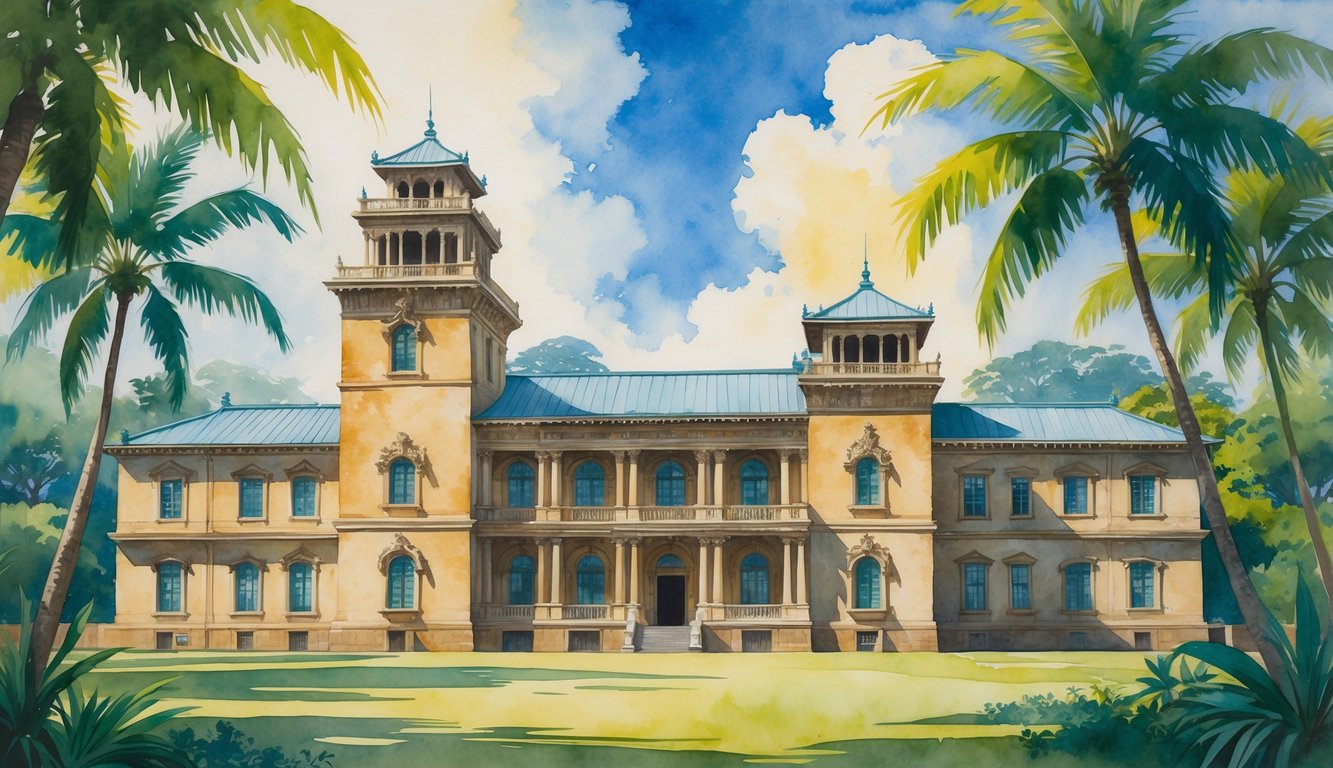
In 1893, political tensions in Honolulu led to the end of Hawaii’s monarchy.
The royal palace became a government building and later a historic site restored to reflect its original appearance.
The Overthrow of the Hawaiian Monarchy
In January 1893, the Committee of Safety, made up of mostly American and European residents, organized the overthrow of the Hawaiian monarchy.
They opposed Queen Liliʻuokalani’s plans to replace the Bayonet Constitution of 1887, which had reduced royal power and increased foreign influence.
U.S. Minister John L. Stevens and U.S. Marines from the USS Boston supported the committee in ending the monarchy.
The queen yielded her authority to the United States government, expecting restoration of her position.
Queen Liliʻuokalani’s Imprisonment
In 1895, after a failed royalist uprising, authorities arrested Queen Liliʻuokalani and tried her for allegedly aiding the rebels.
She spent about eight months confined in a second-floor room of ʻIolani Palace.
During her imprisonment, she read, wrote, and composed songs.
She signed a formal abdication to secure the release of supporters who had been jailed.
Officials later removed her personal belongings, and many palace furnishings were sold at public auction.
Provisional Government and Republic of Hawaii
After the overthrow, the provisional government took control of the palace and used it as its headquarters.
In 1894, the Republic of Hawaii was established with Sanford B. Dole as president.
The palace served as the executive building for the republic.
When Hawaii became the Territory of Hawaii in 1898 under U.S. annexation, the palace continued as the capitol building.
It remained the seat of government until 1969, when the new state capitol opened nearby.
Restoration and Preservation Efforts
By the late 1960s, the palace had suffered from heavy use and neglect.
Restoration began in 1970, led by the Friends of ʻIolani Palace and the Hawaii Department of Land and Natural Resources.
Architect Geoffrey Fairfax guided the work.
Crews focused on structural repairs, repainting, and replacing missing details based on historical records.
Volunteers and staff tracked down and returned many original furnishings sold in the 1890s.
The palace reopened to the public as a museum in 1978.
It now showcases royal history and Hawaii’s political changes.
ʻIolani Palace in Modern Times
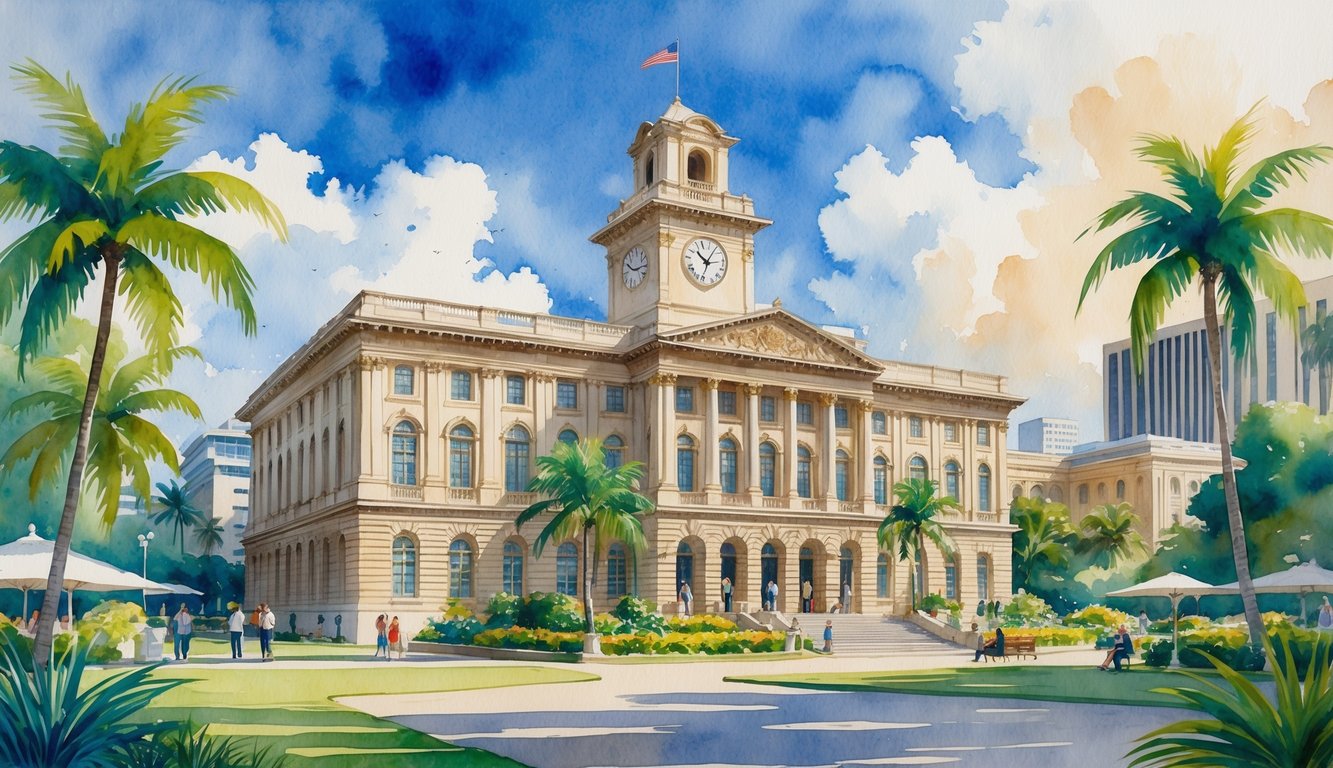
Today, ʻIolani Palace stands as both a preserved royal residence and an active gathering place in Honolulu.
It protects Hawaiian history and serves as a space for public learning, cultural expression, and community connection.
Cultural Legacy and Community Engagement
ʻIolani Palace remains a symbol of Hawaiian identity and sovereignty.
It is the only royal palace in the United States and is recognized as a National Historic Landmark.
The palace grounds often host community events such as commemorations of the Hawaiian monarchy, hula performances, and cultural festivals.
These activities help residents and visitors engage directly with traditions that shaped the islands.
Special events sometimes mark important dates in Hawaiian history, including the birthdays of King Kalākaua and Queen Liliʻuokalani.
The Friends of ʻIolani Palace, a nonprofit group, organizes these gatherings and maintains the site.
Public ceremonies often include music, protocol, and the Hawaiian language.
This reinforces the palace’s role as a living cultural space.
Tourism and Educational Programs
ʻIolani Palace attracts many visitors who are interested in architecture and history. Guided tours show guests the restored rooms and explain the monarchy’s daily life and the political changes that led to its overthrow.
The museum inside the palace displays original furnishings, royal regalia, and artifacts collected through years of research. The palace staff have recovered and returned many items that were lost or sold after the monarchy’s fall, according to Iolani Palace’s official site.
Educational programs offer school field trips, lectures, and workshops. These programs teach Hawaiian history in a clear and engaging way.
Special evening tours and seasonal exhibits give returning visitors new experiences. The palace remains a historic treasure and an important part of Honolulu’s cultural life.


