
When I visit Hawaii, I learn a bit of the Hawaiian language to connect with the islands and their people in a more meaningful way.

Knowing a few simple Hawaiian words and phrases makes my trip smoother and shows respect for Hawaiian culture.
I find that using basic greetings or expressions leads to warmer interactions and helps me feel more welcome.
The Hawaiian language, also called ʻōlelo Hawaiʻi, is more than just another way to speak.
Many place names, signs, and everyday words come from Hawaiian, so knowing some basics helps me get around and enjoy the islands.
If I want to greet someone, I say “aloha,” or thank them by saying “mahalo.”
For more everyday phrases and tips, I check guides like this Hawaiian Language Pronunciation Guide before my trip.
The Significance of the Hawaiian Language for Visitors
When I spend time in Hawaii, I quickly notice how important the Hawaiian language is to the local people.
It shapes daily life and helps me connect with island culture.
Using even simple Hawaiian phrases lets me show respect.
Cultural Importance
Learning about the Hawaiian language helps me understand the spirit of the Hawaiian islands.
ʻŌlelo Hawaiʻi is tied closely to the history of Hawaiian culture.
By learning a few Hawaiian words, I feel more welcomed and show respect for local customs.
The language connects the people of Hawaii to their ancestors, keeping the stories and songs of the past alive.
Native speakers often use Hawaiian in ceremonies and community gatherings.
This makes every simple phrase, like “aloha” or “mahalo,” carry extra meaning.
When I use Hawaiian phrases, locals appreciate my effort.
It also helps me connect better during cultural tours or island celebrations.
The Role of Hawaiian in Everyday Life
I see and hear the Hawaiian language everywhere in the Hawaiian islands.
Street signs, school programs, and government offices use both English and Hawaiian, since ʻŌlelo Hawaiʻi is an official language of Hawaii.
For visitors like me, using Hawaiian words—like “lei,” “ohana,” or “aloha”—makes daily moments feel special.
Locals greet each other with “aloha” and thank people with “mahalo.”
Knowing these Hawaiian phrases helps me navigate shops, markets, and beaches.
If I learn Hawaiian basics, I build positive connections.
Even a short list like:
- Aloha – Hello, goodbye, or love
- Mahalo – Thank you
- Ohana – Family
shows I care about the culture and want to be courteous.
It reminds me that I am a guest in a place where language is a living part of island life.
Getting Started: Essentials of the Hawaiian Language
When I began learning Hawaiian, I found that understanding the basics made daily conversations and reading simple words easier.
The patterns in the Hawaiian alphabet, pronunciation guides, and grammar rules helped me build a strong foundation.
The Hawaiian Alphabet
The Hawaiian language uses only 13 letters.
There are five vowels: a, e, i, o, u, pronounced like in Spanish:
- “a” as in “car”
- “e” as in “bet”
- “i” as in “ski”
- “o” as in “go”
- “u” as in “flute”
The eight consonants are h, k, l, m, n, p, w, and the ‘okina, which is a glottal stop.
The ‘okina (‘) looks like an apostrophe and breaks up words, changing their meaning and pronunciation.
For example, “moa” means chicken, but “mo’a” with the ‘okina means cooked.
Understanding the Hawaiian alphabet helps me read road signs, menus, and simple phrases.
Key Pronunciation Tips
Pronouncing Hawaiian words correctly matters because a word can mean something different if said wrong.
Each vowel is pronounced clearly and does not blend with the next letter.
Consonants have soft sounds.
The “w” is sometimes pronounced like a “v,” depending on its place in the word.
The ‘okina is a brief pause, like in “Hawai‘i.”
The kahakō is a line over a vowel that makes it longer.
A word like “mālama” uses the kahakō to hold the “a” sound a little longer.
If I am unsure how to say something, I listen to interactive pronunciation guides or repeat after local speakers.
Basic Grammar Rules
Hawaiian grammar is simple in some ways and unique in others.
There are no separate words for “he,” “she,” or “it.” Instead, “ʻo ia” refers to all three.
Plural is usually formed with context or by using special words like “nā” for “the” (plural).
The verb usually comes first in a Hawaiian sentence.
For example:
- “Aloha ʻoe” means “I love you” (“Aloha” is the verb, “ʻoe” is “you”).
Hawaiian often relies on context.
There usually isn’t a word for “the” or “a” unless needed for clarity.
I keep a Hawaiian dictionary handy when I’m learning new grammar or building sentences.
Useful Hawaiian Words and Phrases for Visitors
When I visit Hawaii, I learn a few key words to make my trip smoother and show respect to locals.
These simple Hawaiian words and phrases help me greet people, ask for help, and say thank you.
Common Greetings and Expressions
I start my day by saying Aloha, which means hello, goodbye, or love.
It’s more than a greeting—it’s a way to show kindness.
In the morning, I use Aloha kakahiaka to say good morning.
For good evening, I say Aloha ahiahi.
When I’m leaving, I use A hui hou, which means “until we meet again.”
Using these greetings warmly helps me connect with those I meet.
Here’s a quick list of useful greetings:
| Hawaiian Phrase | Meaning |
|---|---|
| Aloha | Hello, goodbye, love |
| Aloha kakahiaka | Good morning |
| Aloha ahiahi | Good evening |
| A hui hou | Until we meet again |
For more greetings, I use this Hawaiian language guide.
Essential Everyday Words
Certain Hawaiian words appear often as I travel.
Mahalo means thank you, and I use it every day.
If I want to emphasize my thanks, I say Mahalo nui or Mahalo nui loa.
Signage and directions often use Hawaiian words.
Makai means toward the ocean, and mauka means toward the mountains.
Locals use these terms for directions.
Ohana means family, wahine means woman, and haole is a term for a non-Hawaiian person.
Pupu means appetizer or snack.
These basic words help me in shops, restaurants, or when asking for guidance.
You can see more Hawaiian everyday terms at this essential phrases for travelers page.
Polite Phrases and Apologies
Being polite goes a long way.
I use Mahalo for thank you and try to say it with gratitude.
If I want to be more formal, Mahalo nui loa expresses deep thanks.
When I need to apologize or get someone’s attention, I say E kala mai, which means “excuse me” or “I’m sorry.”
It’s helpful when I make a mistake or need to ask a question.
If I’m invited to join a group, I might hear E komo mai, which means “welcome.”
When I’m meeting new people or joining an event, I listen for the word hui, which means club or group.
These polite phrases help me build good relationships wherever I go.
For more ideas, I check the Hawaii Tourism Authority’s glossary.
Conversational Tips: Speaking Hawaiian With Confidence
When I learn Hawaiian, I show respect for Hawaiian culture and connect better with others.
Even a few words help me join everyday conversation and feel more welcome with native speakers.
Joining Everyday Conversation
I use simple Hawaiian phrases to make a difference.
Words like “Aloha” mean hello, goodbye, and even love or kindness.
Saying “Mahalo” for thank you is always appreciated.
Asking “Pehea ʻoe?” means “How are you?” and opens up friendly chats.
To help remember these, I keep a short list in my phone or notebook:
| Hawaiian | English |
|---|---|
| Aloha | Hello / Goodbye |
| Mahalo | Thank You |
| Pehea ʻoe? | How are you? |
| ʻAe | Yes |
| ʻAʻole | No |
I listen closely to how native speakers say words.
Sites like the Hawaiian Language Pronunciation Guide let me hear real examples.
This helps me match the sounds and speak with more confidence.
Mistakes happen while I learn Hawaiian, but most people appreciate the effort and are happy to help me.
Making Connections Through Language
Using the Hawaiian language is more than just saying words. I show respect and build trust with my Hawaiian friends, hosts, or tour guides.
Even a small gesture, like greeting someone with “Aloha,” makes a big difference. When I visit, I learn key words tied to family or community, such as “ʻOhana” for family and “Kuleana” for responsibility.
I ask questions about words I don’t know. This helps me learn and shows I care about the culture.
Using new phrases connects me to the spirit of aloha. I try to use Hawaiian phrases in daily life whenever I can.
For more essential words and helpful tips, I check this list of Key Hawaiian Words and Phrases.
Pidgin and Its Influence on Hawaii’s Language
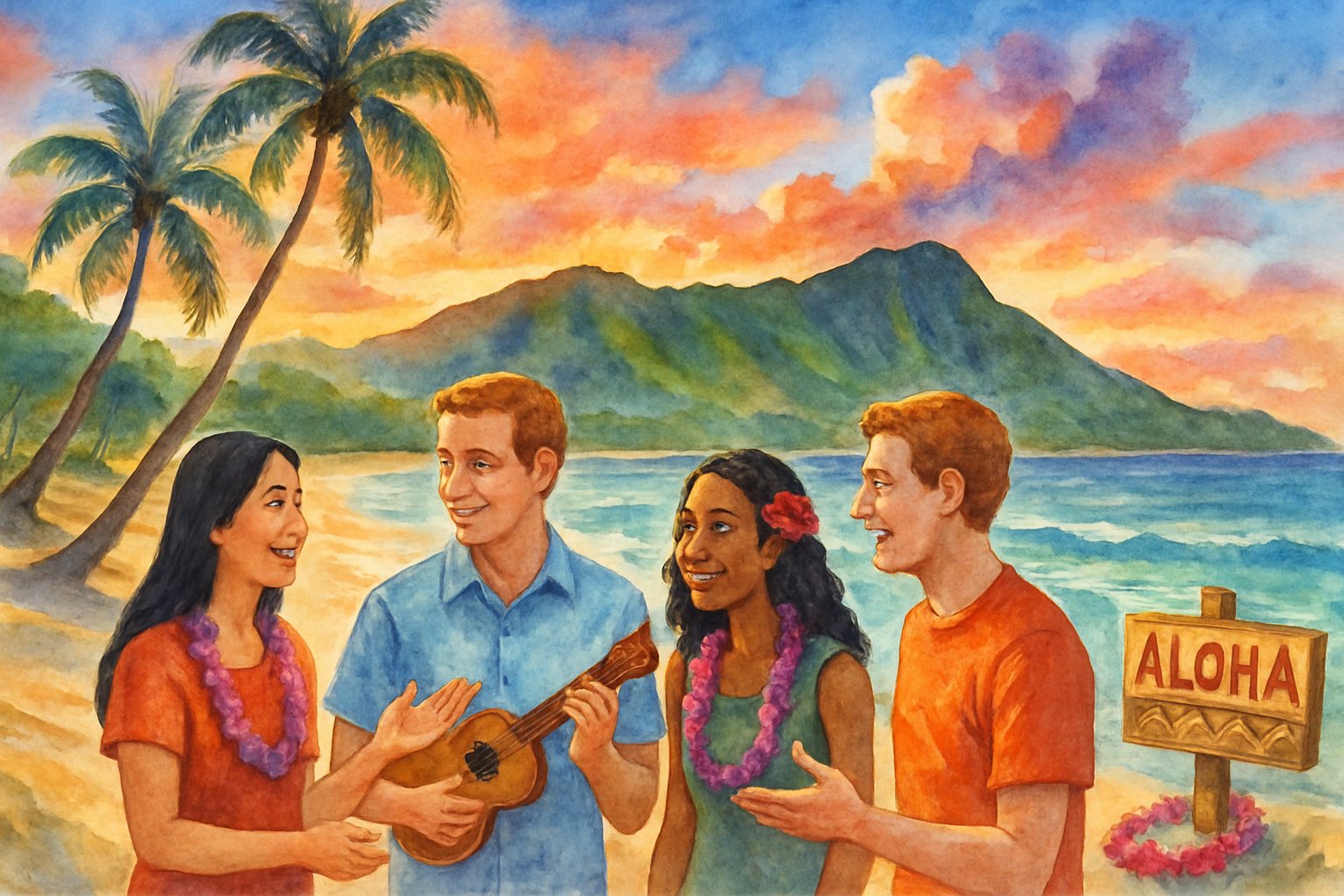
People in Hawaii speak Pidgin everywhere, from schools to shops. When I visit, knowing what Pidgin is and how it differs from Hawaiian helps me understand locals better.
What Is Pidgin?
Pidgin, also called Hawai‘i Creole English, started as a way for people from different backgrounds to talk with each other. Workers from Japan, Portugal, the Philippines, and China brought their languages to the sugar plantations, and Pidgin grew from this mix.
Pidgin uses words and grammar from English, Hawaiian, and several Asian languages. This blend makes Pidgin unique.
Today, many people across the islands still speak Pidgin. It feels local and casual.
Some well-known Pidgin words and phrases include “da kine” (meaning anything or everything), “pau” (finished), and “howzit” (how are you?). I hear Pidgin in daily talk, on television, and in music.
To learn more about common Pidgin phrases, I visit this list of Pidgin slang words.
Pidgin Versus Hawaiian Language
Pidgin and the Hawaiian language are not the same. Hawaiian is an indigenous language with its own history, grammar, and words.
Hawaiian uses only 13 letters and sounds different from English. For example, “Aloha” means both love and hello in Hawaiian.
Pidgin is a creole based mainly on English mixed with other languages. Pidgin developed on plantations, while Hawaiian existed long before that.
Most people in Hawaii speak English and may also use Pidgin. Some know Hawaiian, especially at schools that teach Hawaiian culture.
When I listen or read, I can tell Hawaiian by its simple, vowel-heavy words. Pidgin mixes words from many languages in one sentence.
More about how Pidgin and Hawaiian relate is in this beginner’s guide to Pidgin.
Experiencing Hawaiian Language in Local Culture
I hear the Hawaiian language everywhere I go in Hawaiʻi, especially in music, dance, and community gatherings. Understanding these cultural displays helps me feel more connected as a visitor.
Language in Songs and Dance
When I watch hula, I see how much of the Hawaiian language is woven into every movement and chant. Hula dancers use their hands, faces, and eyes to share stories.
The songs, called mele, are written in Hawaiian and passed down for generations. Listening to traditional mele at events gives me a sense of old Hawaii.
Words and phrases describe the land (ʻāina), the ocean (kai), and feelings that English sometimes cannot express. Locals often say “chicken skin” when the music gives them goosebumps.
Learning a few basic Hawaiian phrases helps me follow along or even sing with the group. If I’m unsure about a word, I use a Hawaiian pronunciation guide.
Hawaiian Words at Events and Festivals
At every luau or community festival I attend, I hear common Hawaiian words like aloha (love, hello, goodbye), mahalo (thank you), and ʻohana (family). Announcers and performers greet everyone, bless the food, and thank the crowd with these words.
Sometimes, signs and menus appear in both Hawaiian and English. Using simple words like aloha and mahalo shows respect for Hawaiian culture.
At larger gatherings or parades, speakers often switch between English and Hawaiian during speeches or blessings. This mix helps keep the language alive, especially for younger generations.
Local guides explain that saying these phrases connects me to Hawaiʻi’s history. I show I care about the traditions of the people I am visiting.
For more on why the Hawaiian language means so much to locals, I found helpful details in this Hawaiian language guide.
Tips for Learning and Practicing Hawaiian
I learn Hawaiian best by combining online resources with real-life conversations. Talking with locals helps me build both vocabulary and confidence.
Resources for Beginners
I start with websites that offer simple guides and audio clips. Interactive resources, like audio pronunciation tools at Go Hawaii, help me hear how words should sound.
Listening and repeating helps me remember basic greetings, numbers, and common phrases. I read language basics and essential words used by locals, such as ‘aloha’ for hello or goodbye, or ‘mahalo’ for thank you.
I use an online Hawaiian dictionary to look up new words. Some websites break down sentences and grammar for beginners to help me understand sentence structure.
I like online courses or language apps for daily practice because they remind me to study. Here are some ways I practice:
- Listen and repeat with pronunciation guides
- Read short word lists every day
- Look up words in a Hawaiian dictionary
- Follow sample phrases for travelers like those at Hawaii.com)
Practicing With Native Speakers
Talking with native speakers helps me improve my Hawaiian. I ask questions and repeat what I hear to make sure I am saying things correctly.
Locals in Hawaii often help visitors learn. They offer tips or correct my pronunciation so I get better each time.
I join local events or cultural classes to learn common words and phrases used in conversation. Practicing with a partner or tutor helps me hear different accents and learn slang.
If I can’t meet in person, I join online forums or video calls with native speakers. Practicing with real people helps my language skills grow.
I learn Hawaiian words and grammar, and I also understand the culture better. People appreciate the effort, and it makes my experience in Hawaii richer.


