
When I think of Hawaii, I picture beautiful beaches, lush forests, and powerful volcanoes. Some of the most famous volcanic eruptions in Hawaii have shaped the islands and influenced local culture and history.

Volcanoes like Kīlauea, Mauna Loa, and Hualālai have erupted many times. These dramatic displays attract people from all over the world.
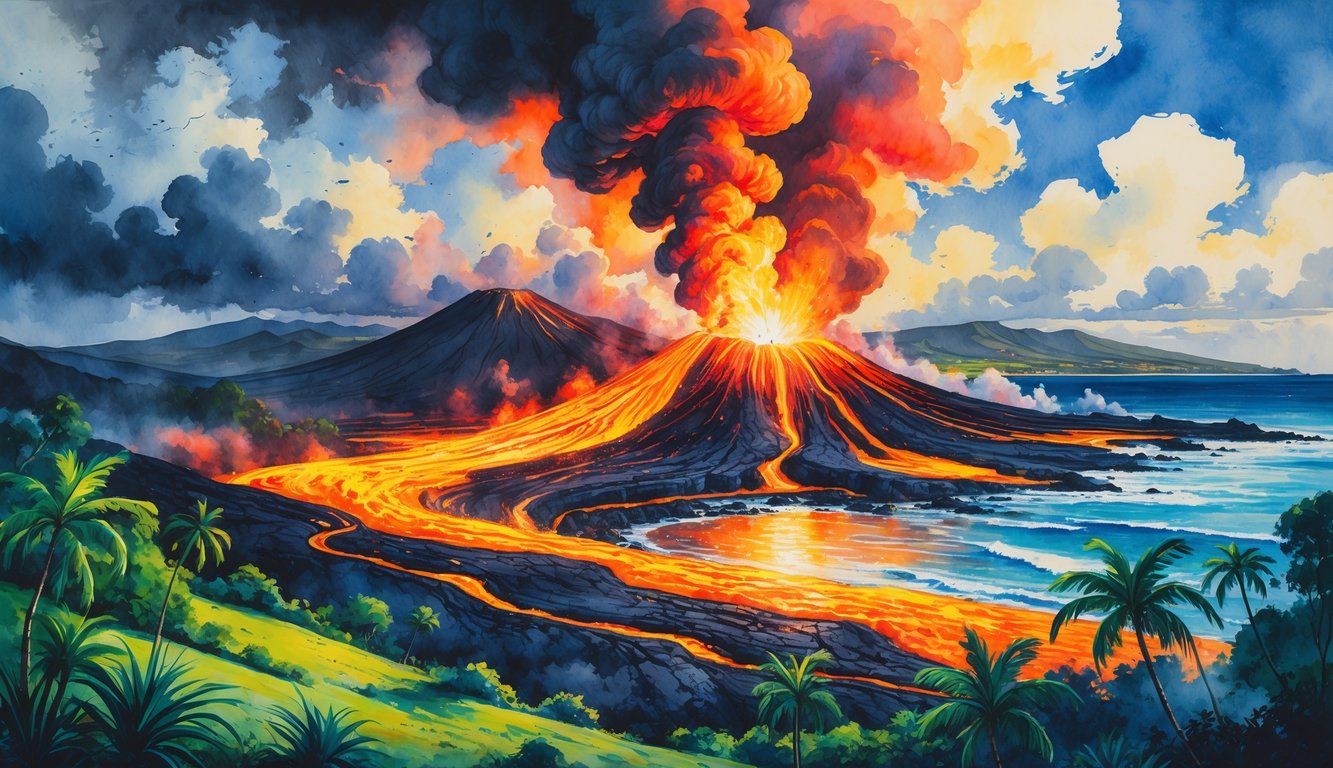
The Hawaiian islands are home to several active volcanoes, including Kīlauea. Kīlauea is one of the world’s most active volcanoes.
Volcanic eruptions here are dangerous, but they also create new land and change the landscape. Scientists study these eruptions to learn more about how our planet works.
If you’re curious about which eruptions made history and why these volcanoes matter to Hawaii, keep reading.
The stories of these eruptions are full of excitement and wonder. Each episode shows how the power of nature continues to shape life in Hawaii.
Understanding Hawaii’s Volcanic Landscape
Hawaii’s natural beauty comes from powerful volcanic forces. The landscape was shaped by lava flows, unique volcanic features, and ongoing eruptions.
The Formation of the Hawaiian Islands
The Hawaiian Islands formed over a “hotspot” in the middle of the Pacific Ocean. Magma from deep inside the Earth pushes up through the ocean floor.
As magma reaches the surface, it cools and hardens. Over time, this process builds large underwater mountains called seamounts.
Some of these seamounts eventually break the ocean surface and become islands. The Pacific plate moves over the hotspot, so new islands keep forming in a chain.
Kauai is one of the oldest islands, while the Big Island of Hawaii is the youngest and still growing. This process created the unique chain of islands we see today.
The sight of black lava fields next to green rainforests shows that Hawaii’s history is one of both destruction and renewal. For more information, check out Hawaii volcano facts and information.
Types of Volcanoes in Hawaii
Not all volcanoes in Hawaii look or act the same. I notice the difference between broad, gently-sloped shield volcanoes and smaller, steeper cinder cones.
Shield volcanoes form from flowing lava that spreads out and creates a wide, shield-like shape. The largest islands feature these shield volcanoes.
Cinder cones are much smaller and form when lava is thrown into the air, then falls back as fragments around the vent. These cones can appear on the flanks of larger volcanoes.
Lava domes also exist, but they are much rarer in Hawaii. The landscape varies because of these different volcano types.
For example, Mauna Loa is a massive shield volcano, while cinder cones create rough, rocky patches. You can read more about the volcanic landscapes of Hawaii.
Active Volcanoes of Hawaii
Several active volcanoes make Hawaii one of the most geologically exciting places. Kīlauea and Mauna Loa, both on the Big Island, erupt regularly and continue to add new land.
Kīlauea is especially active and often draws visitors hoping to see flowing lava or glowing crater vents. Mauna Loa, the world’s largest shield volcano, last erupted in the early 2020s and scientists monitor it closely.
Mauna Kea, though dormant now, was once extremely active and is the highest point in Hawaii. On Maui, Haleakalā remains dormant, but scientists watch it for any signs of activity.
These volcanoes shape the islands’ future as much as their past. Find more details at A Guide to Every Famous Hawaii Volcano.
The Significance of Eruptions in Hawaiian Culture
Volcanic eruptions have shaped the Hawaiian Islands physically and spiritually. These eruptions are tied to Hawaiian beliefs, legends, and ways of life.
Pele: The Goddess of Fire
In Hawaiian tradition, Pele is the goddess of fire and volcanoes. Many people believe she lives in the crater of Kīlauea, one of the world’s most active volcanoes.
People see Pele as a creator and destroyer, a symbol of nature’s unstoppable force. When an eruption happens, families often leave offerings for Pele, like flowers and food, near the lava flow.
These acts show respect and hope for protection from her power. Pele’s stories shape how people react to volcanic threats and the new land created by lava.
The legends about Pele explain how each eruption is not only a disaster but also a chance for new beginnings. The constant change brought by Pele reminds me that volcanic eruptions are important for both renewal and growth in Hawaii.
This connection links natural events with cultural practices. To learn more about Pele’s impact, read about the cultural significance of Kilauea Volcano.
Historical Accounts of Eruptions
The Hawaiian people have always paid close attention to volcanoes. Early Hawaiians observed volcanic activity and changes in the landscape.
They noticed signs like fresh lava flows, the amount of vegetation, and differences in erosion. These observations helped Hawaiians know which areas were more likely to erupt again.
Ancient chants, stories, and written records tell about eruptions and how communities responded. These stories pass down knowledge about safety and respect for volcanoes.
Eruptions have shaped the land, traditions, and daily life in Hawaii. Volcanic activity’s impact on culture and the environment remains a lasting part of the islands’ identity.
Mauna Loa Eruptions: A Legacy of Activity
Mauna Loa, on Hawaii’s Big Island, stands out as one of the world’s most active volcanoes. Its eruptions have shaped the landscape with powerful lava flows and dramatic changes.
The 1984 Eruption
I remember learning about the 1984 Mauna Loa eruption because it was the volcano’s first eruption in almost a decade. The eruption began at the summit caldera, called Moku‘āweoweo.
Lava quickly burst from fissures and flowed down the mountain’s slopes toward the city of Hilo. Thankfully, the lava stopped before reaching homes, but the event kept everyone alert for days.
The eruption lasted for about three weeks. Scientists from the USGS installed extra monitoring gear around the volcano to track its lava flows and steam vents.
This eruption reminded everyone how quickly a massive volcano like Mauna Loa can impact the Big Island. The eruption’s lava flows covered large areas and changed the face of the mountain.
Many images from this event appear in textbooks and news stories today. Visit this summary to see details and effects of the 1984 Mauna Loa eruption.
Notable Past Mauna Loa Eruptions
Mauna Loa has erupted 33 times since 1843. Most eruptions start at the summit caldera, then lava can break out on the rift zones and travel many miles down the slopes.
These events have sent lava flows all the way to the ocean, changing coastlines and burying landscapes. Some eruptions lasted only a few days, while others went on for several weeks.
These flows have covered over 800 square kilometers of land since the first well-recorded eruption. Sometimes, lava flows cut off roads and threatened towns, so scientists watch Mauna Loa closely today.
Learn more about these detailed Mauna Loa eruptions and how they changed the Big Island.
Kīlauea’s Remarkable Volcanic Events
Kīlauea is Hawaii’s most active volcano. Its frequent eruptions and flowing lava constantly reshape the landscape.
Recent history features powerful events and striking changes in both the East Rift Zone and the famous Halema‘uma‘u crater.
The 2018 Lower East Rift Zone Eruption
In 2018, Kīlauea experienced one of its largest eruptions in history. The Lower East Rift Zone split open, sending rivers of lava through neighborhoods and forests.
Entire communities, like Leilani Estates, suffered heavy damage. More than 700 homes were destroyed, and nearly 2,000 residents evacuated.
The eruption released over one cubic kilometer of basaltic lava, covering roads and reshaping the land. Toxic gases forced officials to close several parks and roads for safety.
During the same time, a magnitude 7 earthquake struck the island, causing more destruction and leading to the largest summit collapse in over a century. You can read more about the 2018 eruption’s impact on the USGS Kīlauea page.
Ongoing Activity at Halema‘uma‘u Crater
Kīlauea’s summit caldera, Halema‘uma‘u, often serves as a focal point for volcanic activity. Since 2008, the crater has frequently filled with a glowing lava lake, creating a spectacular nighttime display.
Each eruption brings dramatic changes—the lava lake grows and drains, leaving behind steaming vents and altered crater walls. Eruptions at Halema‘uma‘u are usually less explosive but can shoot lava fountains high in the air.
In March 2025, for example, lava spewed over 1,000 feet up, catching the attention of visitors and scientists. The frequent eruptions at Halema‘uma‘u mean the site is closely monitored.
Find up-to-date information at Hawaiʻi Volcanoes National Park’s Kīlauea overview and through other news reports.
Other Significant Hawaiian Volcano Eruptions
Volcano eruptions have shaped the Hawaiian Islands in many ways. Some eruptions stand out for their size or their impact on people and landscapes.
Hualālai’s Explosive Episodes
Hualālai rises above the western shore of the Big Island. It is less active than Kīlauea or Mauna Loa.
In 1801, Hualālai erupted and sent fast-moving lava to the Kona coast. The lava destroyed coastal villages and left a large area covered in black rock.
Hualālai is younger than Mauna Kea. It has erupted several times in the last 3,000 years.
Besides lava, Hualālai has sent out explosive ash, which is rare for a Hawaiian volcano. Today, many homes and resorts sit close to its slopes.
A future eruption could threaten local residents. Hualālai’s crater and cinder cones still show signs of its active past.
Scientists monitor Hualālai closely because of its history and the risks it poses to the Kona area. For more on its history, explore details about Hualālai’s eruptions at Hawaii.com.
Mauna Kea’s Ancient Eruptions
Mauna Kea is the highest mountain in Hawaii. It stands even taller than Everest when measured from base to summit under the ocean.
Its last eruption happened about 4,600 years ago. Today, Mauna Kea is dormant.
Mauna Kea’s eruptions are very rare. Ancient lava flows shaped the mountain’s ridges and valleys.
Deep cinder cones are easy to see on its summit. Early Hawaiians used Mauna Kea’s hard basalt rock to make tools and weapons.
The summit is also famous for its observatories because the skies are clear. Learn more about Mauna Kea at Big Island’s volcano guide.
Eruptions of Haleakalā on Maui
Haleakalā covers much of Maui and is famous for its large summit crater. This volcano last erupted in the 1700s, sending lava flows to the coast near La Perouse Bay.
These flows created black fields that visitors can still see today. Haleakalā’s eruptions have always been smaller and less frequent than Kīlauea’s.
Younger lava flows made the lush hills and valleys of east Maui, which are good for farming. Hawaiian legends say the demigod Maui lassoed the sun from its summit.
Now, the mountain is a national park with hiking trails. You can still see the effects of its eruptions in the rugged landscape.
For facts about Haleakalā’s eruptions, visit Town & Tourist’s list of top Hawaii volcanoes.
Underwater and Submarine Volcanic Activity
Submarine volcanoes in Hawaii play a key role in how the islands grow and change. Many active volcanoes are hidden deep below the ocean and shape the sea floor in unique ways.
The Growth of Lō‘ihi Seamount
When I look at Hawaii’s volcanoes, Lō‘ihi Seamount stands out because it is completely underwater. Lō‘ihi, also called Kama‘ehuakanaloa, sits about 22 miles southeast of the Big Island.
This active submarine volcano rises more than 10,000 feet above the ocean floor. Its summit is still about 3,200 feet below the water’s surface.
Lō‘ihi has erupted several times in the past 150 years. It is one of the youngest and most active volcanoes in Hawaii.
Lō‘ihi’s eruptions happen out of sight, so new land forms beneath the waves. Over thousands of years, these eruptions may eventually push the seamount above sea level and create a new Hawaiian island.
Scientists track its growth closely. Underwater images show both fresh and older lava flows on its slopes.
Read more about its history at Hawaiʻi’s Kamaʻehuakanaloa Seamount.
Impacts of Submarine Eruptions
Submarine volcanic activity changes the ocean environment around Hawaii. When Lō‘ihi or other underwater volcanoes erupt, hot lava meets seawater and creates steam, ash clouds, and new chemicals.
These eruptions can quickly build up the seafloor. Sometimes, they cause small earthquakes that people feel on land nearby.
Heat and minerals from submarine volcanoes feed unusual deep-sea life, like bacteria and small animals living near lava vents. Scientists study these areas to learn about life in extreme places and how new land forms underwater.
Only a few submarine eruptions have been seen directly. Their effects shape much of the Hawaiian sea floor.
Find more information about these submarine volcanoes and their impact on Hawaii.
Lava Flows and Their Effects on the Hawaiian Landscape
Lava flows change the Big Island’s land with each eruption. These flows create new ground and also destroy what was already there.
How Lava Flows Shape the Environment
Lava leaves the caldera and moves across the land, covering forests, roads, and houses. This hot rock comes from deep underground as magma rises through cracks.
Once the lava cools and hardens, it adds new land to the island. Some lava flows have extended Hawaii’s southern shore by hundreds of acres.
Lava flows destroy plants and animals in their path. Later, new plants and insects appear on the cooled rock.
Lava tubes form as the outer layer of lava hardens and the inside keeps flowing. These tunnels can stretch for miles and create special habitats.
Case Studies of Major Lava Flow Events
The Kilauea volcano has had dramatic eruptions. In one period, it poured out 1.9 cubic kilometers of lava, covering more than 100 square kilometers.
That flow added about 205 hectares of new land to the Big Island’s southern shore. These eruptions have destroyed homes and farms as lava buried entire communities.
In one case, 181 houses and 13 kilometers of highway disappeared under thick rock. Each event brings new ground for plants, animals, and people to start fresh.
For more examples and details, visit the National Park Service’s information about lava and landscape changes.
The Role of Science and Monitoring
Science and technology help us understand and predict volcanic eruptions in Hawaii. Careful monitoring protects people living near volcanoes and gives scientists a chance to learn from each event.
USGS Hawaiian Volcano Observatory
The USGS Hawaiian Volcano Observatory watches and studies volcanic activity on the islands. This group uses seismometers, GPS, cameras, and gas sensors to track changes in the ground, gases, and temperature.
These tools provide early warnings if eruptions might happen. Staff at the observatory work around the clock to share real-time updates with local officials and the public.
For example, the observatory tracked the 2018 Kīlauea eruption, which included large lava flows and major changes at the volcano’s summit. USGS scientists train people from around the world in how to monitor volcanoes and communicate hazards.
Their research helps improve safety in Hawaii and worldwide. More on their efforts is at USGS’s volcano risk reduction work.
The Importance of Earthquake Swarms
When I hear about an earthquake swarm near a Hawaiian volcano, I know scientists are paying close attention. Earthquake swarms are groups of small quakes that happen over a short time.
These swarms often signal that magma is moving underground. Seismometers are the main tool for detecting earthquake swarms.
These instruments pick up even the smallest ground movements. Scientists use them to spot changes quickly.
Sometimes, a swarm means an eruption could happen soon. It works as an early warning sign.
During the Kīlauea eruptions, earthquake swarms gave scientists early warning. This information led to timely alerts and helped public safety planning.
People in the area could prepare, and emergency crews had time to respond. Monitoring earthquake swarms is one of the simplest and most effective ways to keep an eye on volcanoes.
Learn more on this volcano monitoring and eruption prediction page.
Preserving and Experiencing Hawaii’s Volcanic Sites Today
Hawaii’s volcanic landscapes are both beautiful and powerful. I can explore these wonders safely and help protect their special environments for the future.
Visiting Hawaii Volcanoes National Park
When I visit Hawaii Volcanoes National Park, I see two of the world’s most active volcanoes: Mauna Loa and Kīlauea. The park stretches from the ocean up to high mountain summits.
It lets me walk through rainforests, cinder deserts, and old lava fields. I can stand at the edge of the Kīlauea caldera and watch steam rise from deep cracks.
Some trails lead right up to old lava flows. The visitor center has maps and friendly rangers who share the latest updates about eruptions or closed areas.
There are special programs where I can learn about Hawaiian culture and how people live with volcanoes. If I love to take pictures, there are great viewpoints for crater rims and changing landscapes.
The park is also a UNESCO World Heritage Site, so I know it’s protected for the future.
Current Risks and Safety Precautions
Hawaii has active volcanoes, so I always stay alert. Kīlauea’s eruptions can send lava and ash high into the air.
Eruptions sometimes occur in remote areas that have not seen activity for decades, like the 2024 eruption.
Rangers post signs and give updates about closed zones and dangerous spots. Before I visit, I check the USGS daily volcano updates for the latest information.
I follow rules such as staying on marked trails and wearing sturdy shoes. I also respect barriers around calderas or active flows.
I always bring water and sun protection. If I plan to hike after dark, I carry a flashlight.
Masks or goggles help protect my eyes and lungs if there is volcanic smog (vog) or ash in the air. These steps help me stay safe while exploring Hawaii’s volcanoes.


