King Kamehameha I shaped Hawaiian history in ways that still affect the islands today. He was born in North Kohala on the Big Island and rose from a young aliʻi (chief) to become the first ruler to unite all the Hawaiian Islands under one kingdom.

His leadership made the Big Island the center of political and cultural change in Hawaiʻi.
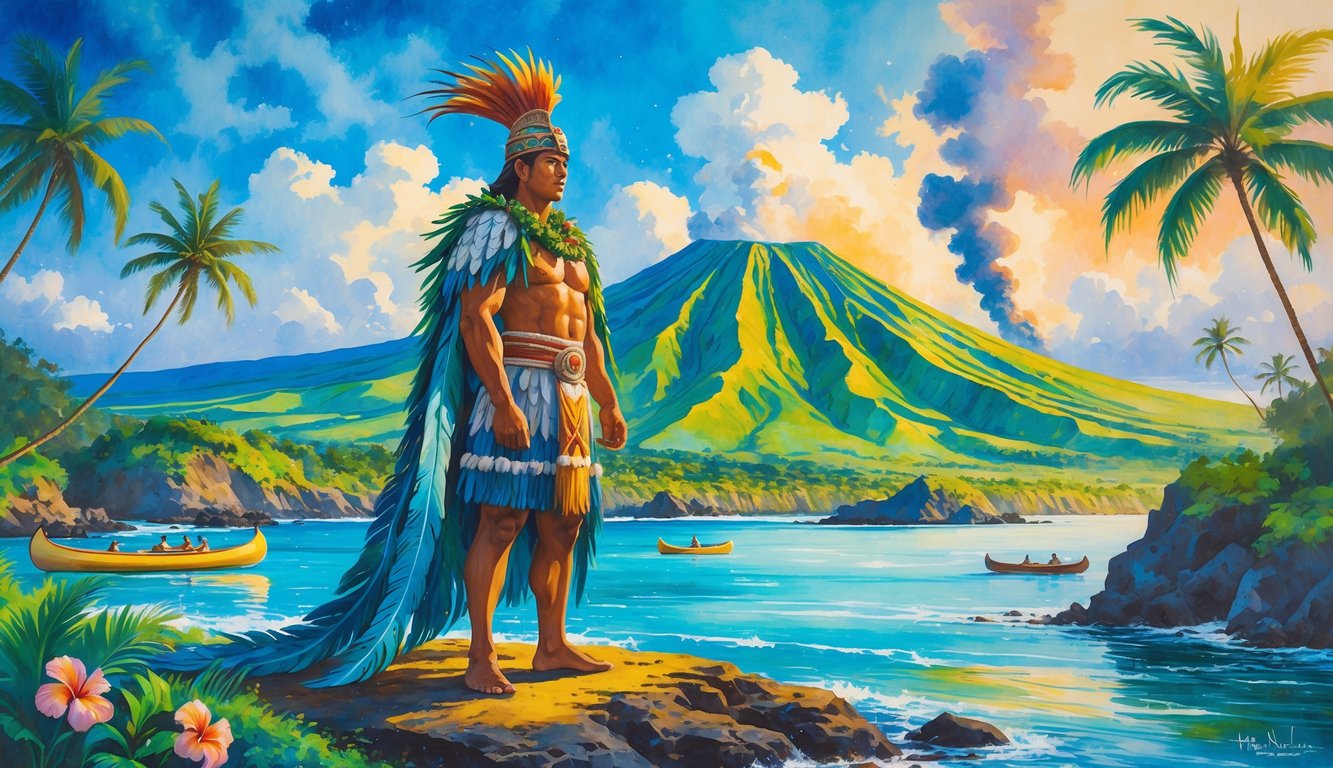
The Big Island played a key role in Kamehameha’s rise to power. Its resources, warriors, and strategic location gave him the foundation to launch campaigns that changed the islands forever.
From battles to alliances, each step of his journey showed both skill and determination.
Learning about King Kamehameha’s unification of Hawaiʻi offers more than a history lesson. His story connects the Big Island’s landscapes to important moments in Hawaiian heritage.
King Kamehameha’s Early Life and Rise on the Big Island
Kamehameha the Great was born during a time of shifting alliances and battles among rival chiefs on Hawai’i Island. His early years in the Kohala District shaped his skills, beliefs, and connections for leadership.
Prophecy and Birth in Kohala
Kamehameha was born in the Kohala District between 1753 and 1761, with many historians suggesting November 1758. He was born as Paiʻea, the son of Kekuiapoiwa, a high-ranking aliʻi woman, and possibly Keōua, a chief of Hawai’i Island.
A prophecy warned that a child born under a rare celestial sign would unite the islands. Some chiefs, fearing the prophecy, tried to harm the infant.
Family members hid Kamehameha in a remote valley in Kohala to protect him. This early danger became part of his legend and strengthened his connection to northern Hawai’i Island.
Visitors today can still see landmarks linked to his birthplace.
Training in Hawaiian Traditions and Lua
As a young aliʻi, Kamehameha learned the skills expected of a leader. Elders and teachers taught him navigation, farming, fishing, and governance.
He also studied lua, the Hawaiian martial art, which taught him close combat, strategy, and discipline. Lua training built his strength, agility, and mental focus.
Religious instruction was important as well. He learned the kapu system and the role of gods in war and politics.
This knowledge helped him command respect from both warriors and priests.
Relationship with King Kalaniʻōpuʻu
Kamehameha grew up under the guidance of his uncle, King Kalaniʻōpuʻu, the aliʻi nui of Hawai’i Island. Kalaniʻōpuʻu saw his nephew’s abilities and included him in military campaigns.
This mentorship gave Kamehameha firsthand experience in leadership and warfare. He fought alongside Kalaniʻōpuʻu in battles to expand and defend the kingdom.
By proving himself on the battlefield, Kamehameha earned a reputation as a strong and capable warrior. His close relationship with Kalaniʻōpuʻu positioned him for future authority in the ruling family.
Inheritance of Kūkāʻilimoku and the Division of Hawai’i Island
When Kalaniʻōpuʻu died in 1782, leaders divided Hawai’i Island. His son Kīwalaʻō became aliʻi nui, while Kamehameha received control of the war god Kūkāʻilimoku.
Holding Kūkāʻilimoku gave Kamehameha spiritual authority in war and strengthened his influence among chiefs and warriors.
This division of power created tension between Kamehameha and Kīwalaʻō. Disputes over land and alliances led to open conflict, setting the stage for Kamehameha’s rise as a unifier of the islands.
Battles, Unification, and the Role of the Big Island
Decisive battles, shifting alliances, and Hawai‘i Island’s strategic value shaped King Kamehameha I’s rise. Military victories, rivalries, and the use of foreign technology all helped bring the Hawaiian Islands under one rule.
The Battle of Mokuʻōhai and Its Aftermath
In 1782, the Battle of Mokuʻōhai marked Kamehameha’s first major step toward unification. The battle took place near present-day Kealakekua Bay on Hawai‘i Island.
Kamehameha faced Kīwalaʻō, the heir to King Kalaniʻōpuʻu. After disputes over land, Kamehameha’s forces, led by skilled warriors like Kekūhaupi‘o, won the battle.
This victory gave Kamehameha control over western Hawai‘i Island. The Mokuʻōhai Battlefield remains a significant historical site, marking his emergence as a dominant leader.
Keōua Kuahuʻula and Internal Rivalries
After Mokuʻōhai, Kamehameha faced strong opposition from Keōua Kuahuʻula, a cousin and rival chief. Keōua controlled large parts of eastern Hawai‘i Island.
Years of skirmishes and shifting alliances followed. Keōua’s forces resisted Kamehameha’s expansion, making unification difficult.
The rivalry ended in 1791 when Keōua traveled to Kawaihae for a meeting with Kamehameha. Historical accounts say Kamehameha’s men killed Keōua on arrival, removing the last major internal threat to Kamehameha’s control of Hawai‘i Island.
Western Weapons and Advisors: John Young and Isaac Davis
John Young and Isaac Davis, two foreigners, gave Kamehameha a major advantage. Both men arrived in Hawai‘i in 1790 after being stranded from ships.
They trained Kamehameha’s warriors to use muskets and cannons. With their guidance, Kamehameha used western weapons in battles on land and sea.
This technological edge helped him win against larger forces, especially during campaigns beyond Hawai‘i Island.
Puʻukoholā Heiau National Historic Site and the Path to Unity
In 1790, Kamehameha began building Puʻukoholā Heiau, a massive temple at Kawaihae dedicated to the war god Kūkāʻilimoku. Workers from across the island built the temple.
The temple symbolized his growing power. Tradition says its completion was tied to a prophecy that Kamehameha would unite the islands.
Today, the Puʻukoholā Heiau National Historic Site stands as one of Hawai‘i’s most important cultural landmarks. It marks the turning point when Kamehameha consolidated control of Hawai‘i Island and prepared to expand his rule.
Kamehameha’s Conquest Beyond Hawaiʻi Island
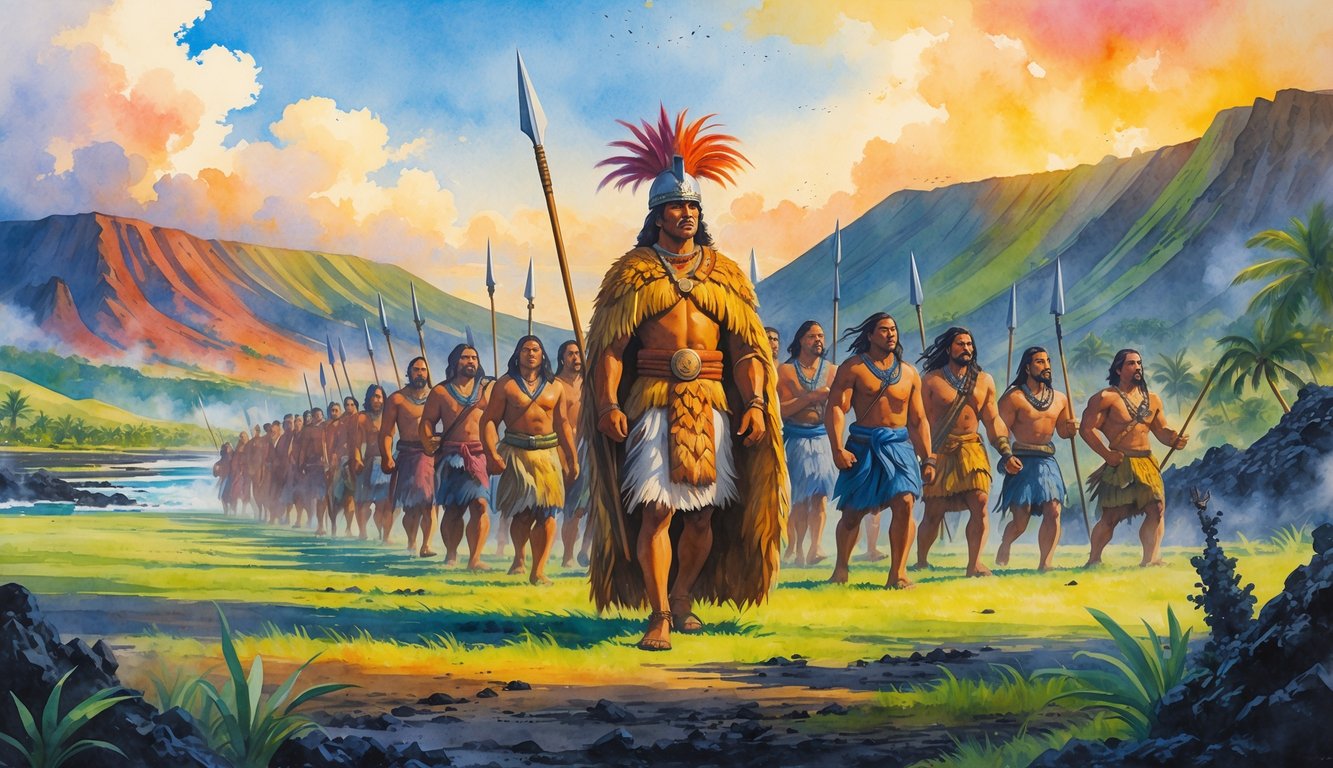
Kamehameha expanded his rule through military campaigns and diplomatic agreements. His efforts brought multiple islands under one authority and reshaped the Hawaiian Kingdom.
Campaigns on Maui and Oʻahu
After securing Hawaiʻi Island, Kamehameha set his sights on Maui. In 1790, his forces fought Maui’s army at the Battle of Kepaniwai in ʻĪao Valley.
Kamehameha’s use of muskets and cannons gave him a major advantage. Maui fell under his control after this victory, though resistance remained in some areas.
Next, Kamehameha prepared to take Oʻahu, an important island for trade and resources. In 1795, his fleet sailed from Hawaiʻi Island with thousands of warriors.
They landed at Waikīkī and pushed inland toward Nuʻuanu Valley, setting the stage for a famous battle.
The Battle of Nuʻuanu Pali and Nuʻuanu Pali Lookout
The Battle of Nuʻuanu Pali was a decisive clash between Kamehameha’s forces and Oʻahu’s defenders led by Chief Kalanikūpule. Fighting moved up the Nuʻuanu Valley, with Kamehameha’s troops pressing the defenders toward the cliffs.
Using both traditional weapons and firearms, his forces overwhelmed the opposition. Many of Kalanikūpule’s warriors were driven over the cliff, ending organized resistance on Oʻahu.
Today, the Nuʻuanu Pali Lookout offers views of the battlefield and the Windward Coast. It remains a historic site that connects visitors to this turning point in Hawaiian history.
Negotiations with King Kaumualiʻi: Kauaʻi and Niʻihau
Kauaʻi and Niʻihau were the last islands outside Kamehameha’s control. In 1796, he tried to invade Kauaʻi, but storms and an uprising on Hawaiʻi Island forced him to turn back.
A second attempt in 1804 was halted by a disease outbreak among his troops. Kamehameha then chose diplomacy with King Kaumualiʻi of Kauaʻi.
In 1810, Kaumualiʻi agreed to become a tributary ruler under Kamehameha’s authority without bloodshed. This peaceful agreement brought Kauaʻi and Niʻihau into the Hawaiian Kingdom, completing the unification of the islands.
Establishing a Centralized Government
With the islands united, Kamehameha created a centralized government to maintain order and manage resources. He balanced the power of local chiefs with the monarchy’s authority.
He implemented laws such as the Kānāwai Māmalahoe (Law of the Splintered Paddle) to protect civilians during conflict.
The new government standardized taxes, trade rules, and foreign relations. These changes strengthened the Hawaiian Kingdom and allowed it to function as a single political entity across the islands.
Legacy, Laws, and Cultural Impact of King Kamehameha
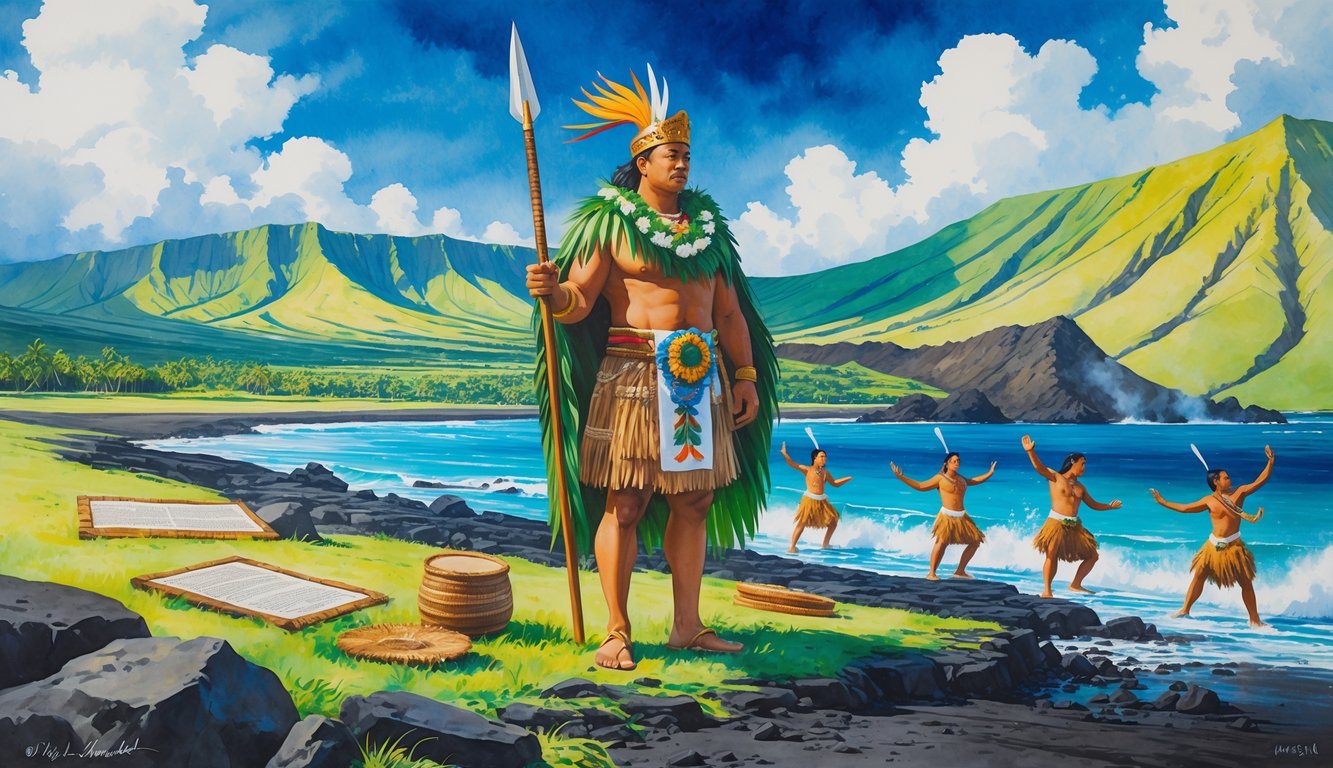
King Kamehameha I changed Hawaii through his legal reforms and protection of cultural practices. His legacy lives on in Hawaiian law, traditions, monuments, and celebrations that honor his leadership.
The Law of the Splintered Paddle (Kānāwai Māmalahoe)
Kamehameha I created the Law of the Splintered Paddle, or Kānāwai Māmalahoe, after an incident during a military campaign. While he chased two fishermen, his leg got stuck in a reef, and he became vulnerable.
The fishermen spared his life, even though they could have killed him. This event moved Kamehameha to create a law that protected noncombatants during conflict.
He declared that old men, women, and children could rest by the roadside without fear. Hawaii’s legal tradition later included this law, and the state constitution still recognizes it.
Kamehameha valued justice and the safety of civilians, even in war. The law stands as a symbol of fairness and compassion in Hawaiian governance.
Preservation of Hawaiian Traditions and the Kapu System
Kamehameha kept the kapu system, a set of religious and social laws at the heart of Hawaiian culture. These rules shaped daily life and supported the authority of the aliʻi (chiefs).
He mixed tradition with new ideas. He welcomed trade and technology from foreign ships but made sure Hawaiian traditions stayed respected.
Under his rule, cultural practices like hula, oral history, and religious ceremonies continued to thrive. The kapu system was strict, and breaking it could bring harsh punishment, even death.
Kamehameha enforced these rules to keep order and protect the spiritual structure of the islands.
Kamehameha II and the Succession
After Kamehameha I died in 1819, his son Kamehameha II (Liholiho) became ruler. He and Queen Kaʻahumanu ended the kapu system, starting a major cultural shift.
Many traditionalists felt shocked by this change. The end of kapu also caused some religious practices tied to temple worship to fade.
Kamehameha II ruled for only a short time. He died in 1824 while visiting England.
Modern Remembrance: Statues, Kamehameha Day, and Hawaiian Sovereignty
Today, people honor Kamehameha with statues in places like Kapaʻau, Kailua-Kona, Hilo, and in front of Aliʻiōlani Hale in Honolulu. Visitors and residents come to these monuments to pay respect to the unifier of the Hawaiian Islands.
People celebrate Kamehameha Day on June 11. The day includes parades, lei draping ceremonies, and cultural events.
This holiday helps teach history to younger generations.
Institutions like Kamehameha Schools and the Bishop Museum keep his legacy alive through education and cultural programs.
Many connect his image to discussions about Hawaiian sovereignty. They see his reign as a symbol of self-rule before the islands became a U.S. territory.
For more history on his life and influence, see this detailed overview of King Kamehameha and the Big Island.